AI, Design and Code: what we showed at WordPress Meetup Faro
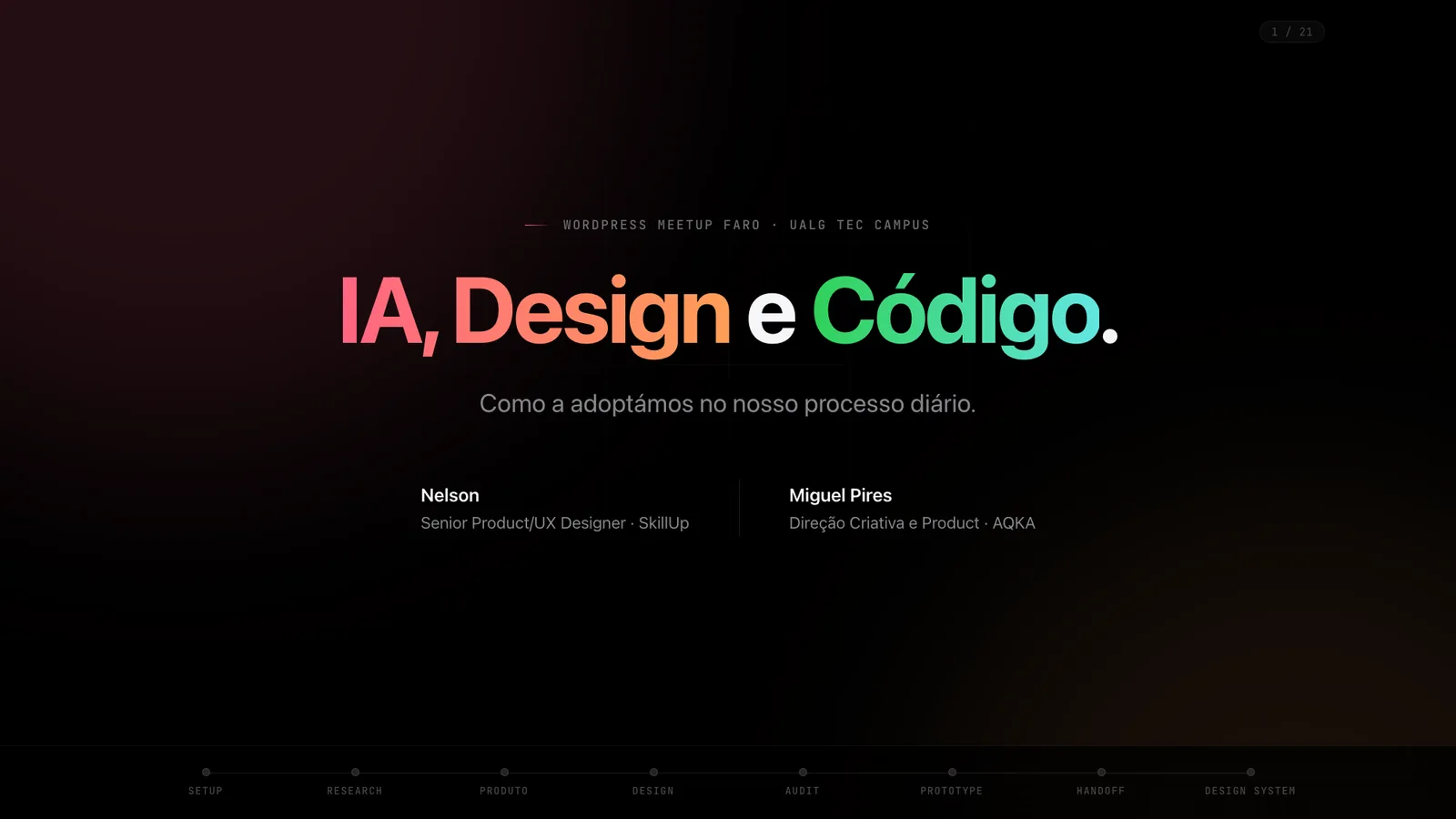
The talk with Miguel Pires (AKQA) at UALG TEC Campus: how AI entered our daily process, from skills and MCP to audit, prototype and handoff.
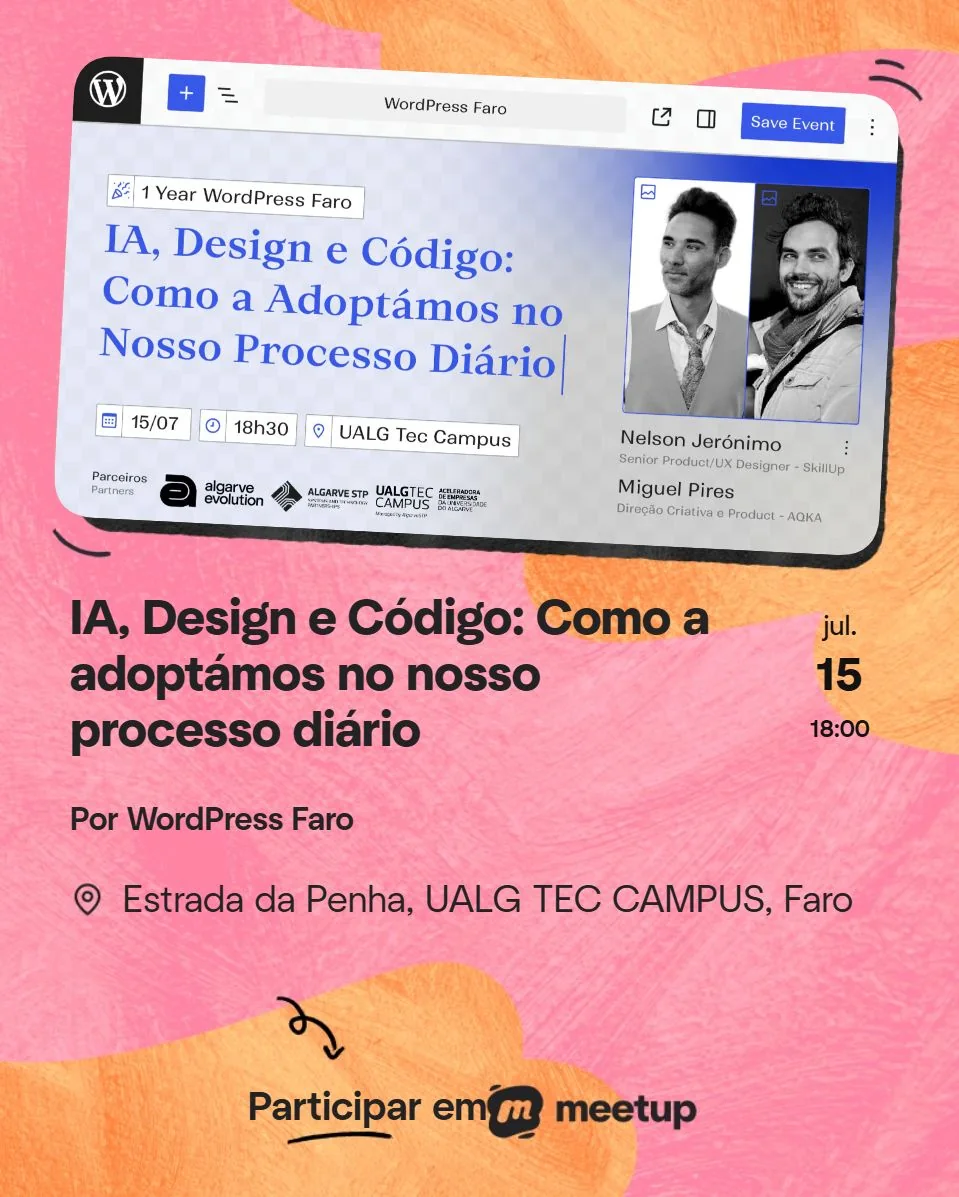
On 15 July I was at WordPress Meetup Faro, at UALG TEC Campus, with Miguel Pires (AKQA), for a practical conversation about how we brought AI into our daily process. No hype and no miracle promises: real examples, from research to deploy, and what still doesn’t work. The talk was in Portuguese, so the slides are too.
The line of the night
A year ago, opening a terminal was the last thing I would have done. Today the terminal works with me, while I keep doing my job as a UI/UX designer and mentor. Everything we showed served one idea:

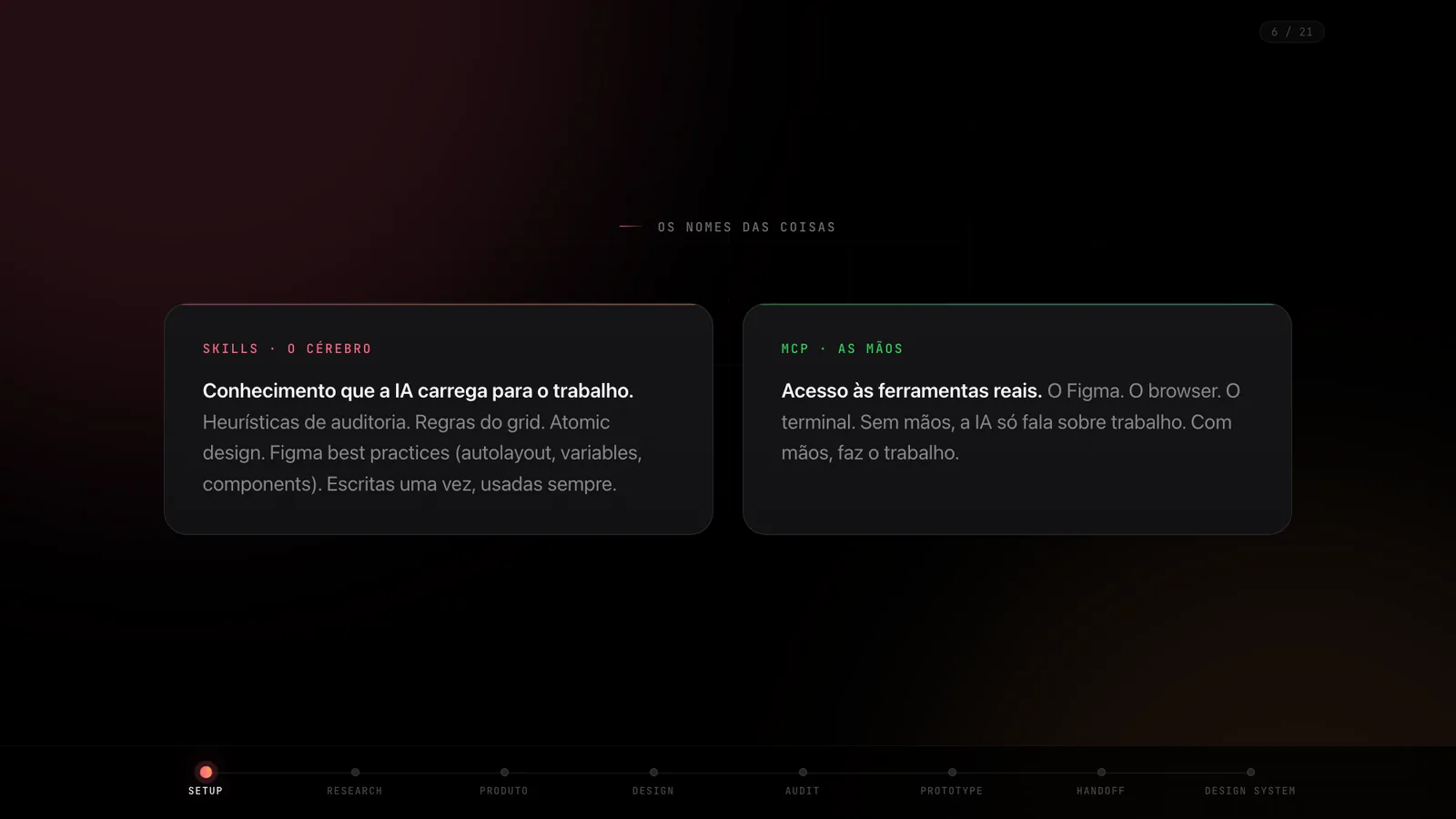
A mental model: skills and MCP
Imagine you hire a brilliant designer who knows nothing about your company. On day one you give them two things: knowledge (your rules, your judgement) and capabilities (access to the tools where the work happens). AI is the same, and both things have names:
- Skills, the brain. Knowledge the AI brings to the work: audit heuristics, grid rules, atomic design, Figma best practice (auto layout, variables, components). Written once, used always.
- MCP, the hands. Access to the real tools: Figma, the browser, the terminal. Without hands, AI only talks about the work. With hands, it does the work.
My daily process, with AI at every step
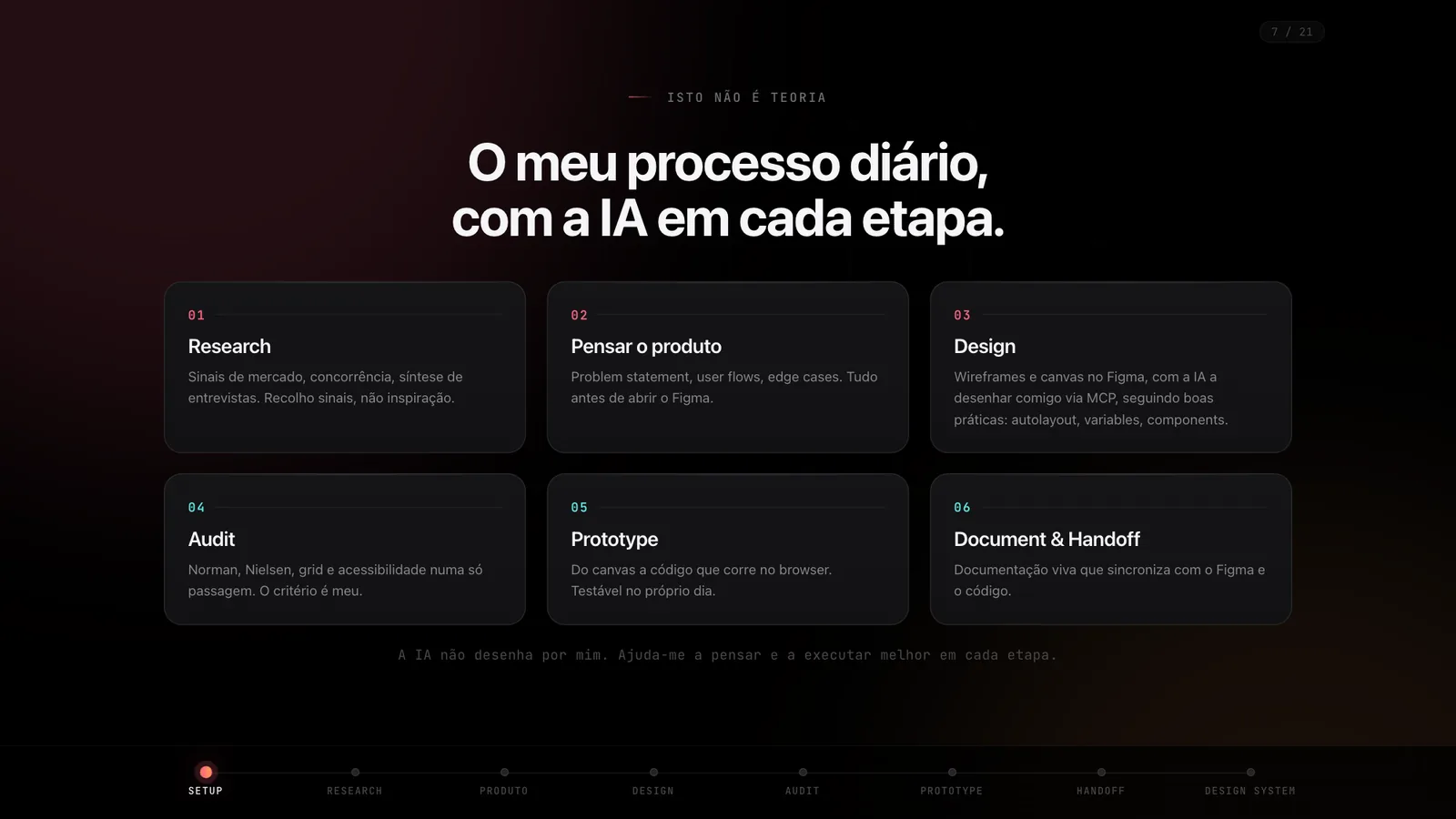
- Research. Market signals, competitors, real user complaints. I collect signals, not inspiration, and reach Figma already knowing where competitors fall short.
- Product thinking. Problem statement, jobs to be done, user flows, MVP and edge cases, all in text before drawing a single screen. AI doesn’t replace thinking: it makes you think first, because you have to write the problem down clearly.
- Design. Wireframes straight into Figma via MCP, with auto layout, variables and components from the start. The file is born organised and ready to scale.
- Audit. I taught AI to audit the way I would, but with more eyes, faster and without fatigue: Norman, Nielsen, grid and accessibility in a single pass. The judgement is still mine. I wrote it once and it applies to every screen.
- Prototype. From canvas to code that runs in the browser, testable the same day. Users test the product, not the mock-up.
- Document and handoff. Handoff stops being just annotations and diagrams and becomes living documentation that syncs with Figma and the code. I test earlier, gaps are smaller and the conversation with the developer starts two weeks sooner.
AI doesn’t design for me. It helps me think and execute better at every step.
What about after deploy?
The second part was Miguel’s: a design system starts going stale the day it’s published, with lagging docs, orphan components and tokens nobody can trace. Maintaining it by hand doesn’t scale. With AI, the design system can document and audit itself: compare Figma with the code, spot drift and flag when something breaks the pattern. And with tokens, one change at the base reaches several brands at once.
Honesty
Everything AI generates needs refining, and the refining is us. That’s why it doesn’t replace us yet.
It’s not just us
Designers in other parts of the world are arriving at the same architecture, with no contact with us: skills as the brain, MCP as the hands. A good read to start with is A Designer’s Guide to Claude Code by Katherine Yeh, on Medium.
The room chose
At the end, the room chose what it wanted to see happen: a live UX audit, wireframes drawn by AI in Figma, a design system in HTML or Storybook, and a working prototype from the canvas.
Thanks to the Portuguese WordPress Community, Algarve Evolution, AlgarveSTP Association and UALG TEC Campus for the invitation and the organisation, and to everyone who came.
The event announcement is on LinkedIn.